
This last spring and summer and started the journey through breaking down the 10 Principles of Intuitive Eating. I’d like to continue that voyage with you and pick up where we left off and dive deeper into principle 4 (Challenge the Food Police) and 5 (Feel Your Fullness).
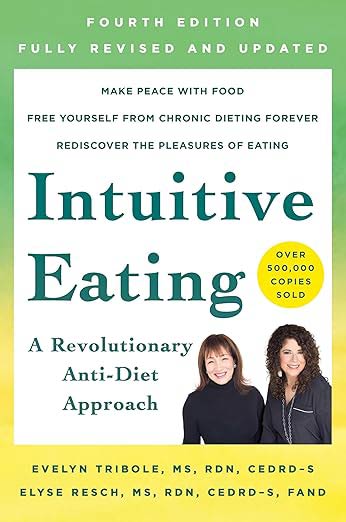
Just to quickly reiterate, authors Evelyn Tribole, and Elyse Resch first published their book The 10 Principles of Intuitive Eating in 1995 and since has been pivotal in the world of eating disorder treatment and the anti-diet-culture. Now in its 4th edition, it continues to be a popular and life-changing approach for so many – including us!
Who are the food police?
For many of us we may have an image in our mind of an elder who would emphasize good and bad foods. This may be your reality, but ultimately, the food police are the internalized voices of diet culture and were also impressed upon the generations before us. They enforce harsh rules:
- “You should eat less today.”
- “That snack is bad.”
- “You don’t deserve to eat that.”
Tribole and Resch describe these voices as “the loudest barrier to self-trust.”
Why Challenging the Food Police Matters
When the Food Police run the show:
- You feel shame instead of curiosity
- You eat based on rules instead of needs
- You disconnect from hunger and fullness
The book emphasizes that quieting these voices allows your “Nurturer voice” to emerge — the part of you that supports your body rather than punishing it. Rather than harshly judging foods as healthy or unhealthy or good vs. bad, encourage yourself to see all foods as equal. Foods are all created with different nutrients, and that is a good thing. Our body doesn’t know the difference between an apple and a chocolate bar, just that it absorbs and uses nutrients from those food items for different reasons. Once we take the power away from the food then it has less hold on us.
Why Challenging the Food Police Matters
This principle can be a bit our abstract, therefore it can be more difficult to put into practice. One of the primary focus areas of this principle is to understand interoceptive awareness.
What Interoceptive Awareness Is
The book describes it simply as “the ability to perceive physical sensations.” An easy example is to realize that your body gives you the signal that you need to go to the bathroom, so you listen and go.
Interoceptive awareness allows you to detect:
- hunger
- fullness
- satisfaction
- emotional shifts
- energy changes
- tension or calm
Diet culture weakens this awareness by teaching you to look outward — at rules, portions, calories, macros — instead of inward. Rebuilding interoceptive awareness is a core goal of Intuitive Eating.
Feeling your fullness is about noticing:
- comfort
- satisfaction
- slowing interest in food
- stomach sensations
But to notice fullness, you need interoceptive awareness.
Stimulus Control and How Screens Disrupt Interoceptive Awareness
Stimulus control is a behavioral concept that refers to changing your environment or routines to make certain behaviors easier and others less likely. In eating psychology, this often means creating surroundings that support eating with awareness rather than automatically or reactively. For example, we do not recommend eating while driving, watching screens, or truly, multitasking at all. Now, we are realistic here at Intuitive Counseling, so we understand and also practice this in moderation. We are all so busy, but if you feel there is a problem with your relationship with food, we encourage you to consider some of these tips.
1. Screens steal attention
When your attention is on scrolling, streaming, or gaming, fewer mental resources remain to sense fullness.
2. Screens reduce sensory engagement
Taste, texture, aroma, pacing — these are essential to noticing fullness and satisfaction.
3. Screens encourage autopilot eating
Without natural pauses, it’s easy to overshoot comfortable fullness.
4. Screens interfere with memory of eating
Research cited in the book shows that distraction reduces “meal memory,” leading to increased hunger later.
Short supporting quote: “Distraction interferes with fullness awareness.”
Supporting Fullness Awareness in Real Life
You don’t need rigid rules. You simply need practices that support connection:
Before eating:
- One slow breath
- “Where is my hunger right now?”
During eating:
- Set your utensil down once or twice
- Sit hands in your lap for a moment or two
- Ask: “Is this still satisfying?”
If using screens:
- Choose low-stimulation content
- Plate your food
- Pause halfway for a check-in
This is not about discipline — it’s about strengthening the ability to hear your body.
How Principles 4 and 5 Work Together
- Challenging the Food Police reduces judgment.
- Reduced judgment increases internal safety.
- Internal safety enhances interoceptive awareness.
- Interoceptive awareness supports hunger and fullness recognition.
- Hunger and fullness recognition rebuild body trust.
As the book states: “These principles work together, not in a straight line.”
If you feel like you would like to have a further discussion on this topic, please contact our team to schedule a session.